
Acne Scars by Type: Why the Treatment That Works for One Won’t Work for Another
Post-acne marks are one of the most common reasons people visit a dermatologist, and one of the most frustrating to address on your own. The problem isn’t product quality or persistence. It’s that most people apply solutions designed for a different kind of scar than the one they actually have. The team at Lumine Dermatology Clinic encounters this pattern constantly: patients come in after months using retinoids or vitamin C serums, certain they’ve been doing the right things, only to find their scarring has barely moved. In most cases, the mismatch between treatment and scar type is the culprit.
There is more variety in what falls under the label of acne scars than most people realize. Some are depressions caused by tissue loss during a breakout; others rise above the skin because the body over-repaired the wound. A few types are so narrow and deep that topical products can’t reach them in any meaningful way. Others respond well to lasers that would do nothing for a different scar a centimeter away. The category is wide, and the variation matters.
The Difference Between Atrophic and Hypertrophic Scars
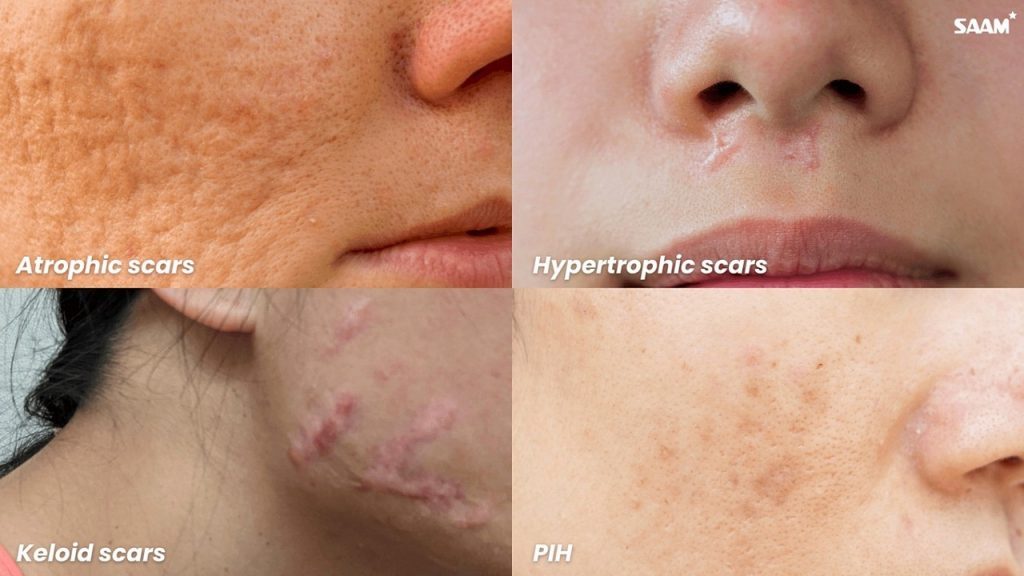
Dermatologists divide post-acne scarring into two broad families before getting specific. Atrophic scars are indented: they form when inflammation destroys collagen and the tissue beneath the skin doesn’t regenerate fully. Hypertrophic scars are raised: they form when the body produces more collagen than it needs during wound repair. Keloid scars sit at the far end of that spectrum, where excess scar tissue grows beyond the original wound boundary. Atrophic scars are far more common overall; hypertrophic and keloid scars tend to cluster on the chest, shoulders, and jawline.
The distinction matters because the logic of treatment runs in opposite directions. Atrophic scars need something to stimulate collagen production and fill in the deficit, whether that’s microneedling, fillers, or resurfacing lasers. Hypertrophic and keloid scars need the opposite: something to suppress excess collagen, like corticosteroid injections, silicone gel, or pressure therapy. Applying a collagen-stimulating treatment to a raised scar won’t help; it can make things worse. A proper assessment before any treatment choice isn’t a formality. It’s the foundation of the whole plan.
Ice Pick Scars: The Deepest and Hardest to Treat
Ice pick scars are deep, narrow channels that extend into the dermis, sometimes reaching the subcutaneous fat. The name is accurate: the skin looks as though it was punctured with something thin and sharp. They’re one of the most common outcomes of cystic acne, which destroys tissue from deep within the follicle rather than close to the surface, leaving a narrow, significant tract once the inflammation finally resolves.
What makes them particularly stubborn is geometry. The opening at the skin’s surface may be less than two millimeters wide, but the channel extends far below where topical products or surface-level lasers can reach. According to the American Academy of Dermatology, ice pick scars often call for punch excision, where a small circular blade removes the entire tract, or a procedure called CROSS (Chemical Reconstruction of Skin Scars), which applies high-concentration trichloroacetic acid directly into the scar channel to stimulate collagen remodeling from the inside out.
Neither is a single-session fix. Most patients require three or more rounds before improvement stabilizes, and that timeline should be part of the conversation before treatment begins.
Rolling and Boxcar Scars: Where Lasers Do Their Best Work
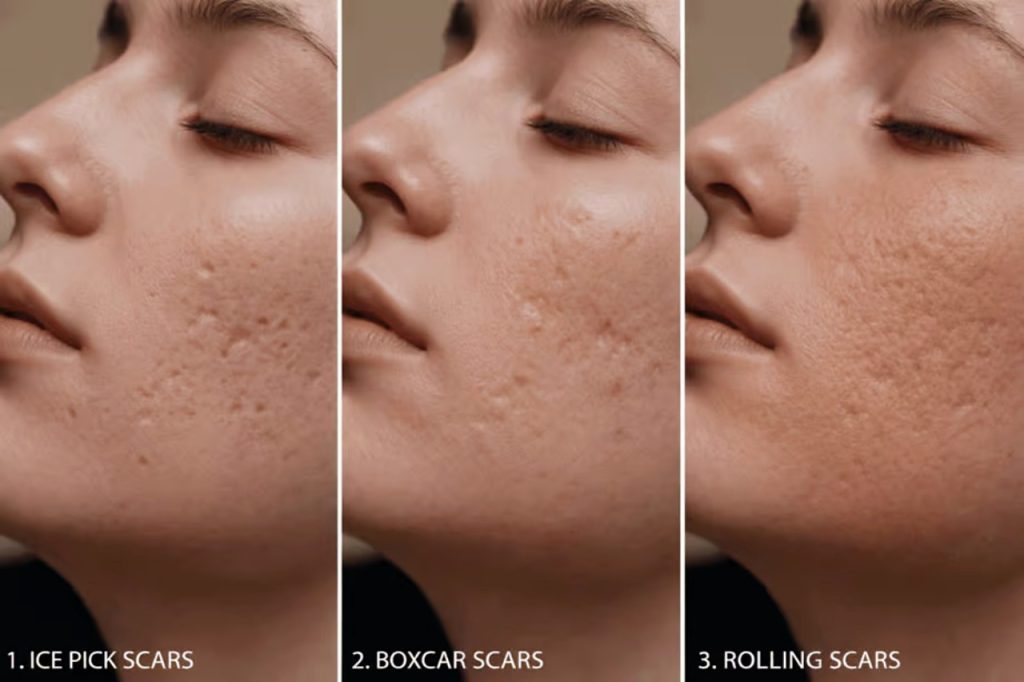
Rolling scars and boxcar scars are both atrophic, but their appearance and underlying causes differ. Rolling scars produce a wave-like, uneven texture across broad stretches of skin because fibrous bands beneath the surface tether the skin unevenly. Boxcar scars have wide, flat-bottomed depressions with clearly defined vertical edges, closer in shape to a small pit than to a narrow puncture. Both types are shallower than ice picks, which opens up a wider range of viable treatments.
Fractional laser resurfacing works well for moderate boxcar scars. For rolling scars, subcision usually comes first: a needle inserted beneath the skin breaks the fibrous tethering bands before any surface work begins. According to NIH research on effective atrophic scar treatments, combination approaches consistently outperform single-modality protocols, which is why subcision and fractional laser are frequently prescribed together. Results continue improving for months after the final session, which is worth accounting for before assuming a treatment didn’t work.
Hypertrophic and Keloid Scars: When the Body Overshoots
Raised scars after acne are less common than atrophic ones, but they’re harder to overlook. Hypertrophic scars stay within the boundary of the original blemish, while keloids extend beyond it, sometimes quite far. The chest, shoulders, and jawline are particularly prone to keloid formation, partly due to higher skin tension in those areas and partly because of genetic predisposition. People with darker skin tones develop keloids at statistically higher rates.
The treatment goal is the reverse of what’s needed for atrophic scars. Rather than building tissue, the aim is to flatten it. Corticosteroid injections, given in a series spaced several weeks apart, reduce the bulk of hypertrophic scars and smaller keloids by suppressing fibroblast activity and breaking down excess collagen fibers. For larger keloids, injections are often paired with cryotherapy or pulsed dye laser to address the vascular component.
Results take months, not weeks. Keloids in particular have a notable recurrence rate, and patients with a prior keloid should expect ongoing monitoring even after a scar looks fully resolved.
Why Professional Assessment Changes What’s Possible
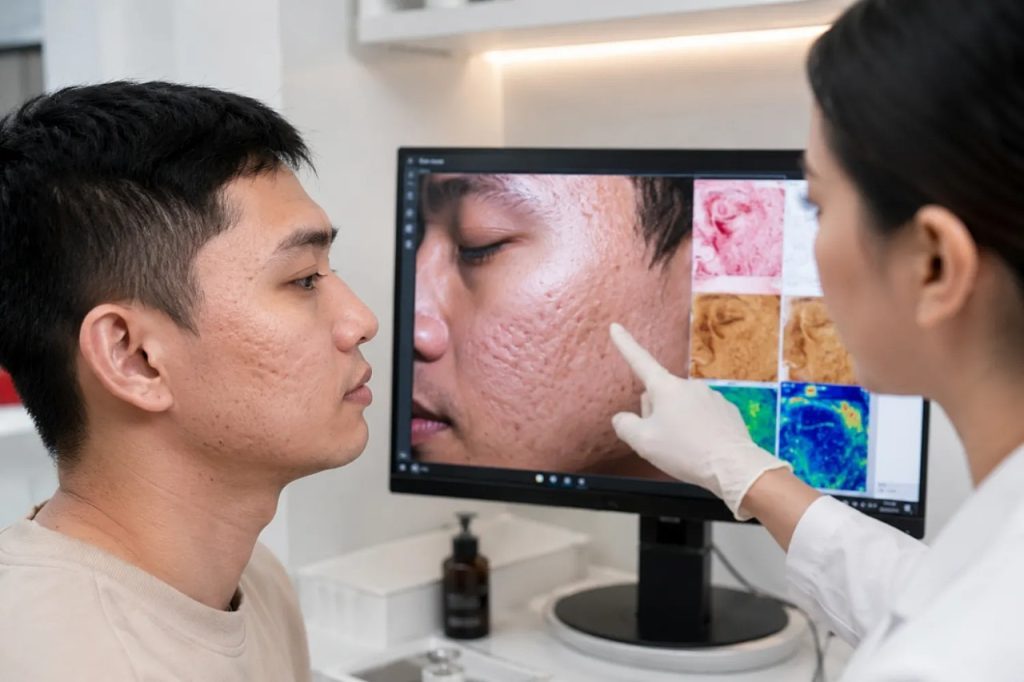
One thing that gets buried in the volume of skincare advice online is that most acne scar treatment requires more than selecting the right product. Many people carry more than one scar type at once without realizing it. A dermatologist might plan subcision for rolling scars in one area while recommending punch excision for ice picks a centimeter away. Those protocols share almost nothing in common, and no single product or procedure covers both needs.
Timing adds another layer of complexity that’s easy to underestimate. Pursuing aggressive resurfacing before acne is stable, or treating scarring while breakouts are still active, typically produces poor results and can create new pigmentation problems. Dermatologists generally advise getting breakouts well controlled before shifting focus to residual scarring. In practice, the patients who see the best results are usually the ones who waited longer than they wanted to before starting.